
Sewer Overflow Monitoring System for Early Warning

A sewer overflow monitoring system is most valuable in the minutes before an overflow becomes visible. By the time sewage reaches a road reserve, waterway, property boundary or stormwater drain, the operational window has narrowed and the environmental, compliance and public health consequences are already escalating. Continuous remote monitoring gives operators earlier evidence of rising levels, restricted flow and abnormal network behaviour so crews can intervene with purpose rather than react to a complaint.
For sewerage authorities, utilities and industrial site operators, this is not simply a telemetry upgrade. It is a practical means of turning dispersed, difficult-to-access assets into an observable network with live condition data, prioritised alarms and an auditable event record.
Why sewer overflows remain difficult to manage
Most sewer overflow events develop from a combination of factors rather than one isolated fault. Fat, oils and grease accumulation can progressively reduce pipe capacity. Rubbish, roots, sediment, collapsed pipe sections, failed pumps and inflow during wet weather can all create hydraulic restrictions. In gravity systems, an upstream maintenance hole may surcharge long before field staff recognise an issue.
Periodic inspections and manual readings have a role, but they provide snapshots. A level taken on a dry weekday morning says little about the network response during an intense rainfall event, a pump duty cycle or a trade waste discharge. The critical changes may occur overnight, during storms or at sites that are expensive and unsafe to inspect frequently.
The operational challenge is therefore to identify abnormal behaviour early enough to prevent or contain an incident. That requires measured evidence at the asset, reliable communications from the field and cloud intelligence that separates a genuine risk from routine short-term variation.
What a sewer overflow monitoring system measures
A properly specified system combines field instrumentation, autonomous telemetry, cloud software and defined response workflows. The appropriate sensor configuration depends on whether the priority is surcharge detection, blockage identification, pump station performance or environmental protection.
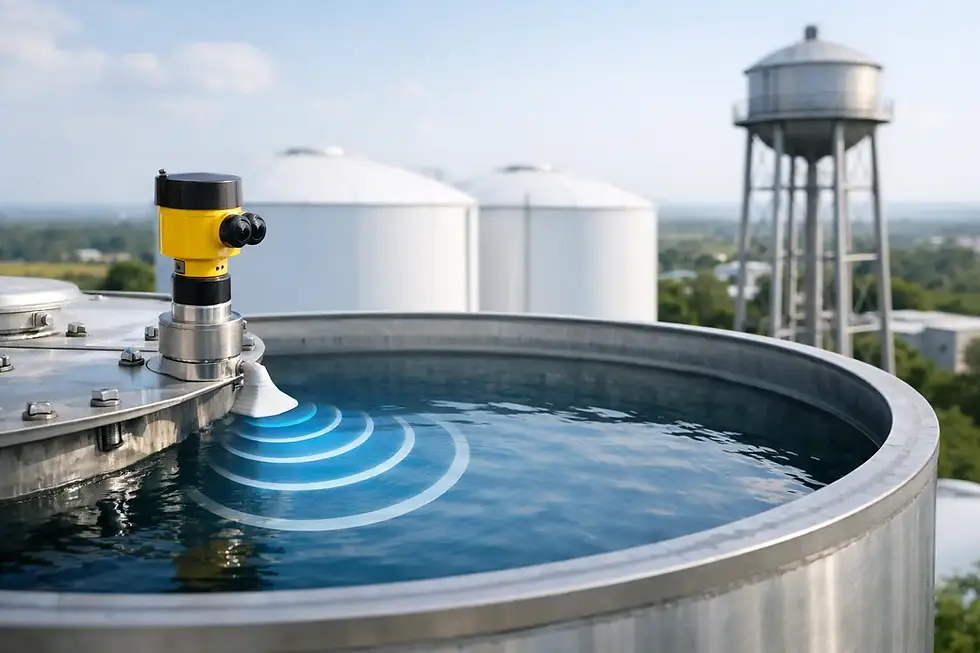
At a maintenance hole, wet well, overflow chamber or critical trunk sewer, non-contact radar level sensors can continuously measure the distance to the wastewater surface. The resulting level trend identifies rising surcharge conditions without placing a sensor directly in corrosive sewage. Radar is particularly useful where rags, turbulence, foam and variable wastewater composition would compromise contact instruments.
Remote flow meters add another layer of operational intelligence. Depending on the location and hydraulic conditions, a utility may monitor velocity, depth, calculated flow or a combination of these parameters. A rising upstream level with falling or unexpectedly static downstream flow can indicate a developing restriction. At pump stations, level data can be assessed alongside pump status, starts, run hours and discharge performance to reveal loss of pumping capacity.
Rainfall data, where available, provides valuable context. Wet-weather infiltration and inflow can produce expected level increases, while a rapid rise in dry weather should receive higher priority. The aim is not to collect every possible parameter. It is to select the measurements that reveal the specific failure modes at each asset.
The value of trend data over single alarms
A high-level alarm alone can warn that a site is close to overflowing. Trend data explains whether the risk is stabilising, worsening or clearing. For example, a level that falls promptly after a pump starts may reflect normal operation. A level that continues rising despite repeated starts suggests reduced pump output, a blocked discharge line, an electrical issue or inflow beyond station capacity.
Cloud dashboards should display current status, historical trends, alarm acknowledgements and mapped asset locations. This enables operations teams to compare multiple sites during an event, determine whether a problem is localised or catchment-wide, and direct crews to the assets with the greatest consequence of failure.
Designing alarms that lead to action
Poorly configured alarms create noise, and alarm noise causes real risks to be missed. A sewer overflow monitoring system must be commissioned around operating thresholds, asset geometry and response capacity rather than a generic high-level setting.
A useful alarm strategy normally includes a pre-warning threshold, a high-level threshold and an escalation condition based on rate of rise or elapsed time. The pre-warning allows an operator to review trends and prepare a field response. The high-level alarm signals an immediate operational concern. A rate-of-rise alarm is especially valuable where levels can increase rapidly during wet weather or when a blockage develops suddenly.
Alarm delays and persistence rules also matter. A brief level spike caused by turbulence should not trigger a crew call-out. Conversely, excessive averaging can conceal a fast-developing overflow. It depends on the site: a sensitive overflow point near a waterway may justify more conservative thresholds and faster notification than a low-consequence maintenance hole with available storage.
Notifications should reach the right personnel through agreed channels and escalation paths. Each alarm needs a clear operational meaning: inspect the asset, dispatch a jetting crew, review pump operation, deploy bypass pumping, notify environmental staff or document the event. Monitoring without a defined response procedure becomes another screen to watch.
Field deployment conditions that determine reliability
Sewer environments are unforgiving. Equipment must operate through humidity, corrosive gases, condensation, vibration, flooding, debris and intermittent mobile coverage. Selecting an instrument solely on laboratory specifications often results in costly maintenance and unreliable data.
Non-contact, sealed sensors reduce exposure to wastewater and can simplify maintenance. Solar-powered remote stations are valuable where mains power is unavailable, but the energy design must account for sensor load, transmission frequency, solar exposure and battery autonomy during extended wet-weather periods. At deep or shaded locations, alternative power arrangements may be more appropriate.
Communications should be assessed site by site. A field-proven deployment uses store-and-forward capability so data is retained when the network is temporarily unavailable and transmitted once communications return. Installation design should also consider safe access, traffic management, confined-space requirements, antenna placement, enclosure protection and the need to retain normal access to the maintenance hole.
Rapid plug-and-play commissioning is beneficial, but it does not remove the need for sound survey information. Accurate invert levels, overflow crest levels, wet well dimensions and asset coordinates are essential for converting raw measurements into useful operating thresholds.
From monitoring data to network intelligence
The strongest outcomes emerge when overflow monitoring is used as an ongoing operational dataset, not merely an alarm service. Repeated high-level events at the same location may justify targeted cleaning, CCTV investigation or capital renewal. Correlating level patterns with rainfall can reveal catchments affected by infiltration and inflow. Comparing pump station level recovery times can identify declining mechanical performance before failure.
This information also supports compliance and environmental reporting. Time-stamped records can demonstrate when an overflow risk began, when alarms were issued, when field actions occurred and how the site recovered. That evidence strengthens incident investigation and helps authorities distinguish asset limitations from unusual external conditions.
For large networks, cloud-based geospatial views allow teams to rank sites by consequence, recurrence and alarm frequency. This supports risk-based maintenance planning instead of relying only on fixed inspection schedules. It also makes pilot programmes easier to scale: once a monitoring configuration proves its value at priority sites, the same architecture can be extended across a catchment.
TracWater India applies this approach through autonomous sensing platforms, remote communications and secure cloud intelligence designed for demanding water and wastewater infrastructure. The emphasis is on field-proven measurement and actionable operational data, not isolated readings that require manual interpretation.
Selecting the right monitoring scope
A full network rollout is not always the right starting point. Many utilities gain faster value by instrumenting known overflow locations, pump stations with a history of surcharge, environmentally sensitive discharge points and upstream sites that provide early warning of downstream constraints. These locations create a practical evidence base for future investment.
The right system should be assessed against measurement accuracy, enclosure and sensor suitability, power autonomy, communications resilience, data ownership, alarm configuration, integration requirements and support for calibration and maintenance. Procurement teams should also ask how easily the solution can move from a small pilot to hundreds of sites without creating separate data silos.
Early warning is only useful when it changes the next operational decision. Start with the sewer assets where a few minutes of reliable notice can prevent an overflow, protect receiving waters and give field crews a clear reason to act.



Comments